Each donation helps to ensure the Museum's activities, allowing it to function and provide information for people from all over the world.
The Museum is grateful to each donor and invites everyone to contribute.
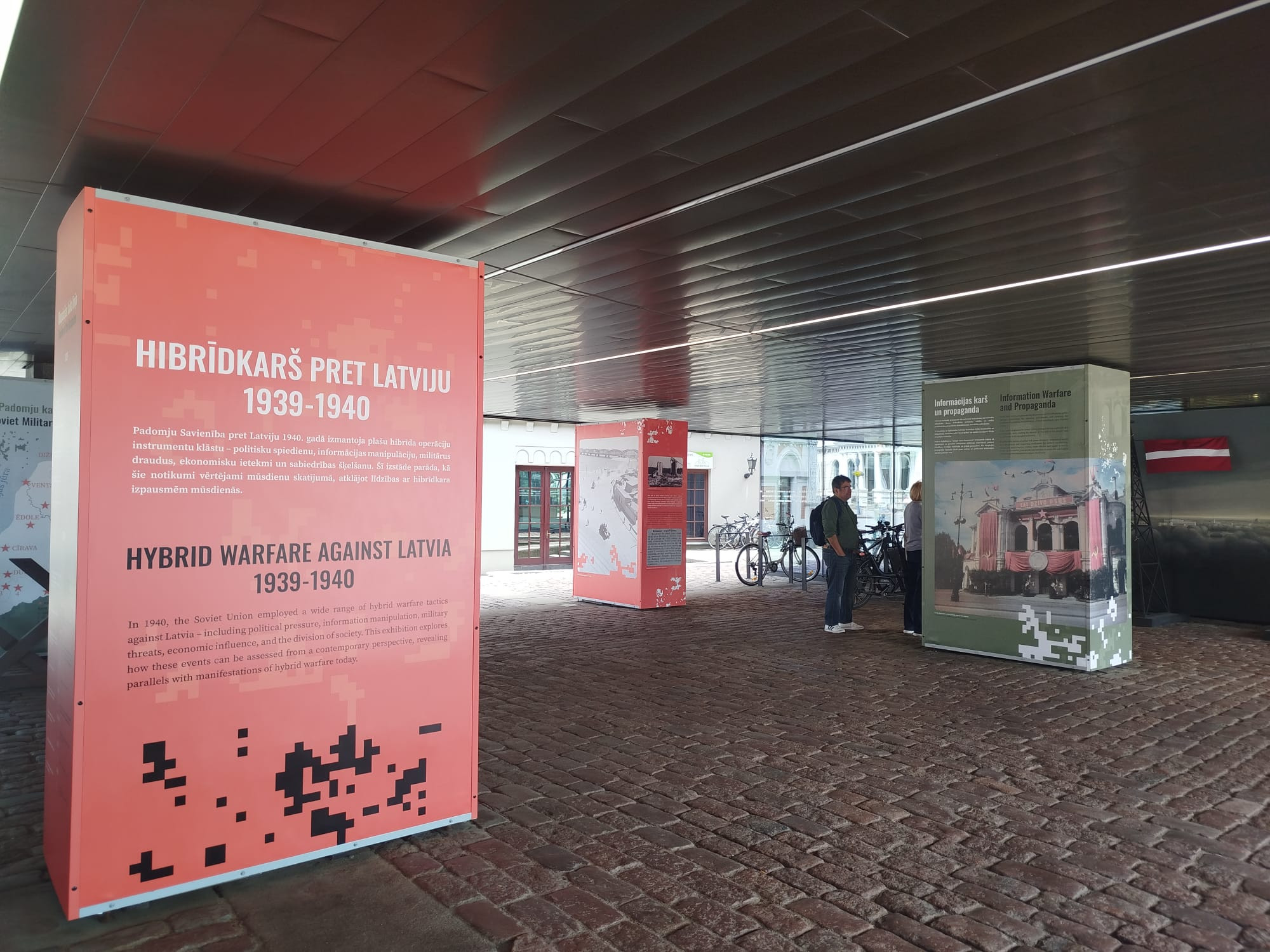
Outdoor Exhibition
HYBRID WAR AGAINST LATVIA. 1939–1940
One of the questions most frequently asked by museum visitors is: How did Latvia reach the point where Soviet tanks rolled into the streets of Riga? The answer lies in a gradual and deliberate process in which totalitarian regimes, step by step, redrew the map of Europe, divided society, and used a variety of tools of influence to achieve their goals. Even today, it is important to recognize these processes and be able to resist them.
This exhibition offers a contemporary perspective on the actions carried out by the Soviet Union against Latvia on the eve of World War II and during the occupation. It reveals that many of the methods we today describe as instruments of hybrid warfare were already being used more than 80 years ago.
The exhibition traces the course of events from the signing of the Molotov-Ribbentrop Pact on August 23, 1939, to the occupation of Latvia and its incorporation into the Soviet Union in August 1940. The exhibition highlights the main elements of hybrid warfare - political and diplomatic pressure, information operations, military threats, economic influence, societal destabilization, the administrative takeover of power, and other instruments used to eliminate Latvia’s sovereignty.
“The events we are witnessing today also compel us to reevaluate the processes of the past. They help us better understand how aggressor states use a combination of various means of influence to achieve their goals, without necessarily resorting to open hostilities. Latvia’s experience in 1939-1940 offers important lessons for understanding the current security situation. The exhibition’s goal is not merely to recount history, but to encourage viewers to look at well-known events from a different perspective,” emphasizes exhibition curator Kārlis Dambītis.
Exhibition creators: Dr. hist. Kārlis Dambītis.
Designers: SIA Delkors.
The exhibition features materials from the Museum of the Occupation of Latvia, the Latvian War Museum, the National Library of Latvia, and the Bundesarchiv.
The exhibition is on view through June 2027 in the outdoor area next to the Museum of the Occupation of Latvia at 1 Latviešu strēlnieku laukums, Riga.
